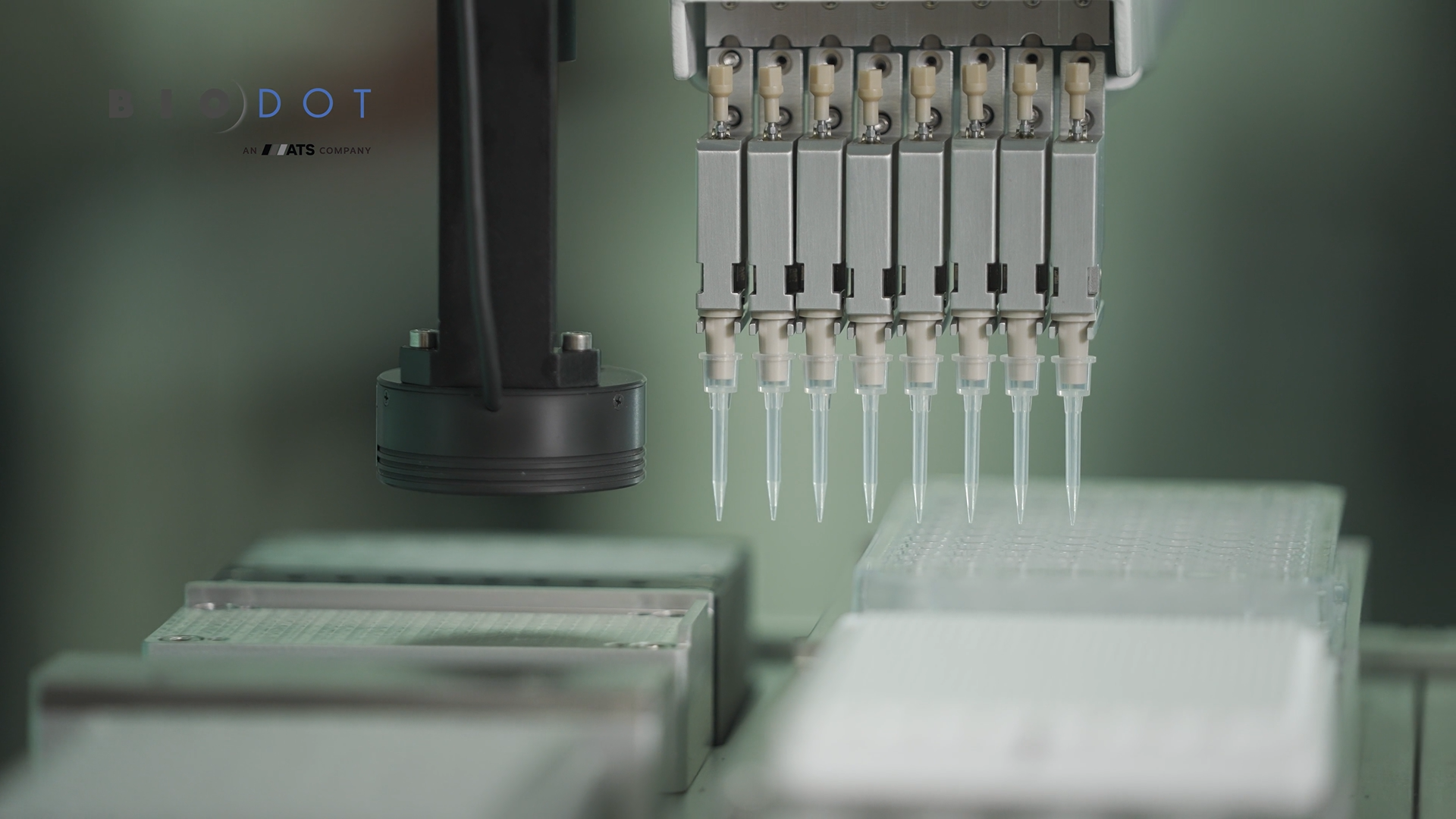
Introducing NANOlab™: A Nanoliter Liquid Handler Built for Real Lab Workflows

Labs are miniaturizing assays to cut reagent costs, increase throughput, and unlock next-generation workflows. But, moving from microliters to nanoliters introduces new challenges: precision, placement, evaporation, and contamination control. Today, BioDot is sharing its latest instrument, NANOlab, built to close that gap as a true nanoliter liquid handler for real lab workflows.
“NANOlab brings nanoliter capability into a platform that behaves like lab automation,” said Brian Kirk, General Manager at BioDot. “Liquid handling means you have a dynamic system that can do complex things, and we built NANOlab with that expectation.”
.webp)
Why Nanoliter Liquid Handling is Becoming Essential
Across genomics, PCR, drug discovery, and emerging multiomics workflows, miniaturization has shifted from a nice-to-have to a necessity. Teams are under pressure to do more with less, using less sample, less reagent, and less hands-on time, while still maintaining consistency and producing more usable data per run.
As assays become more complex and throughput expectations rise, reagent cost becomes a limiting factor, and the value of reliable low-volume automation becomes clearer. Miniaturization also enables more reactions per plate, more data per run, and more efficient use of precious samples. In short, nanoliter workflows are becoming a practical way to keep pace.
The Market Gap: Lab-Ready Nano Capability
Miniaturization is not just turning a dial down. Once you move from microliters to nanoliters, what good automation looks like changes, and many tools fall into one of two buckets:
- Traditional liquid handlers that cannot reliably reach true nanoliter territory, or struggle to do it consistently.
- Nano “printing” approaches that can produce tiny droplets, but do not always map cleanly onto day-to-day lab automation.
“NANOlab is designed to feel like a liquid handler in the lab, not a printer,” Kirk said. “It is about enabling real workflows at nanoliter volumes.”
The Hidden Challenges of Going Nano
At nanoliter scale, teams encounter challenges that do not show up at microliter volumes.
- Placement becomes as important as volume
Dispensing the right amount is not enough. Droplet placement and repeatability matter more than ever, because tiny positional variability can change whether reagents actually meet and react as intended.
- Evaporation becomes a workflow variable
At very small volumes, evaporation can shift concentrations and outcomes, turning something that was once a rounding error into a real source of variability.
- Contamination risk becomes a practical adoption blocker
In many lab settings, teams work with multiple chemistries across changing samples. Cleaning validation can become a time sink and hard to fully trust. “Creating a platform that allows teams to build new workflows at nanoliter volumes without worrying about cross-contamination was a key focus,” Kirk said.
Meet NANOlab: Built for Reagent Savings, Flexibility, and Growth
NANOlab was designed around a simple idea: nanoliter automation becomes truly valuable when it is lab-ready, not just lab-capable. The platform is designed to help teams miniaturize with confidence while keeping workflows practical and scalable.
Reduce Reagent Cost While Maintaining Performance
Miniaturization is often driven by reagent economics. When reactions shrink, reagent spend can drop dramatically, especially in workflows that rely on expensive master mixes, enzymes, or specialty reagents. NANOlab is engineered to support reliable low-volume dispensing so teams can reduce reagent use without sacrificing consistency.
“Nanoliter automation has to deliver better performance while using less reagent,” said David Pfeifer, Senior Product Manager at BioDot. “That means precision and accuracy that labs can rely on.”
Walk-Away Automation to Give Teams Time Back
A key promise of lab automation is freeing researchers from repetitive steps. NANOlab is built to support set-the-run workflows that reduce hands-on time and support repeatable execution.
“NANOlab is about giving teams back time,” said Shane Gunsalus, R&D Engineering Manager at BioDot. “You can build the process, set the SOPs, and hand it off, so researchers can focus on higher-value work.”
Modular Design that Grows with Your Workflows
Workflows evolve, and instruments need to keep up. NANOlab was conceived as a platform that can adapt as applications expand, not a one-off solution tied to a single assay. Its modular, scalable architecture is intended to support long-term use and expansion as needs change. A scalable system matters because miniaturization is rarely a one-step change. Teams often start with one workflow and expand into additional assays, formats, and requirements over time. NANOlab is created to support that progression.
Disposable-tip Nanoliter Dispensing Reduces Friction and Risk
Between runs, contamination concerns and cleaning steps can slow teams down. A disposable-tip approach is intended to reduce operational overhead and help teams move faster when switching between workflows, especially in environments handling multiple chemistries and assay types.
Measurable Performance that Builds Trust Over Time
At nanoliter scale, credibility comes from quantification of data. NANOlab is designed for repeatable performance supported by measurable data, not a one-time demonstration. Consistency over time is what turns nanoliter capability into something teams can operationalize.
The Outcome: Enabling What Comes Next
The value of nanoliter liquid handling is not simply smaller drops. It is what smaller, more consistent volumes make possible: tighter assay economics, higher-density workflows, improved reproducibility, and new assay designs that are difficult or impractical at larger volumes.
“NANOlab enables next-generation assays,” said Thomas Winter, Manager of Sales, Life Sciences & OEM at BioDot. “It is a platform that helps teams miniaturize with confidence and rethink what is possible.” Kirk added that workflow speed matters as much as volume range. “The ability to dispense on the fly is one of the most important things,” he said. “That is what keeps workflows moving.”
What’s Next: Miniaturization Will Keep Moving Forward
Over the next few years, demand will continue trending toward:
- Smaller inputs and tighter precision requirements.
- More multiplexing and higher density workflows.
- Automation that is reliable at low volumes without requiring constant expert supervision.
In that world, the winners will not just have the smallest droplet. They will have the most practical nanoliter workflow, one that is easy to adopt, easy to validate, and robust enough to run via SOPs without constant oversight.
That is the role NANOlab is built to play as a true nanoliter liquid handler for real lab workflows.
About BioDot, Inc.
Founded in 1994, BioDot manufactures precision quantitative fluid dispensing systems. Today with more than 5,500 instruments installed globally, BioDot is one of the largest suppliers of equipment in the diagnostic test market. Specializing in low-volume dispensing, BioDot’s wide range of platforms serves customers from R&D through high-volume manufacturing in the industrial, diagnostic, life science, and medical product markets. A portfolio of proprietary dispensing technologies provides precision, non-contact dispensing from picoliter to microliter volumes. Today BioDot holds over 27 global patents in low-volume dispensing and novel applications that rely on its proprietary dispensing technology. BioDot is a worldwide company with international offices in China and the United Kingdom. BioDot’s long-lasting relationships with customers are built on precision products and quality service around the world.
About the Author
Nora Beik is an Associate Product Manager at BioDot, supporting product strategy and go-to-market execution through customer and market insights. She earned dual bachelor’s degrees in Political Science and International Studies, with a minor in Urban Studies, from the University of California, Irvine (2021), and completed her MBA at the University of California, Irvine (2025) with a specialization in Healthcare Management and Policy.